
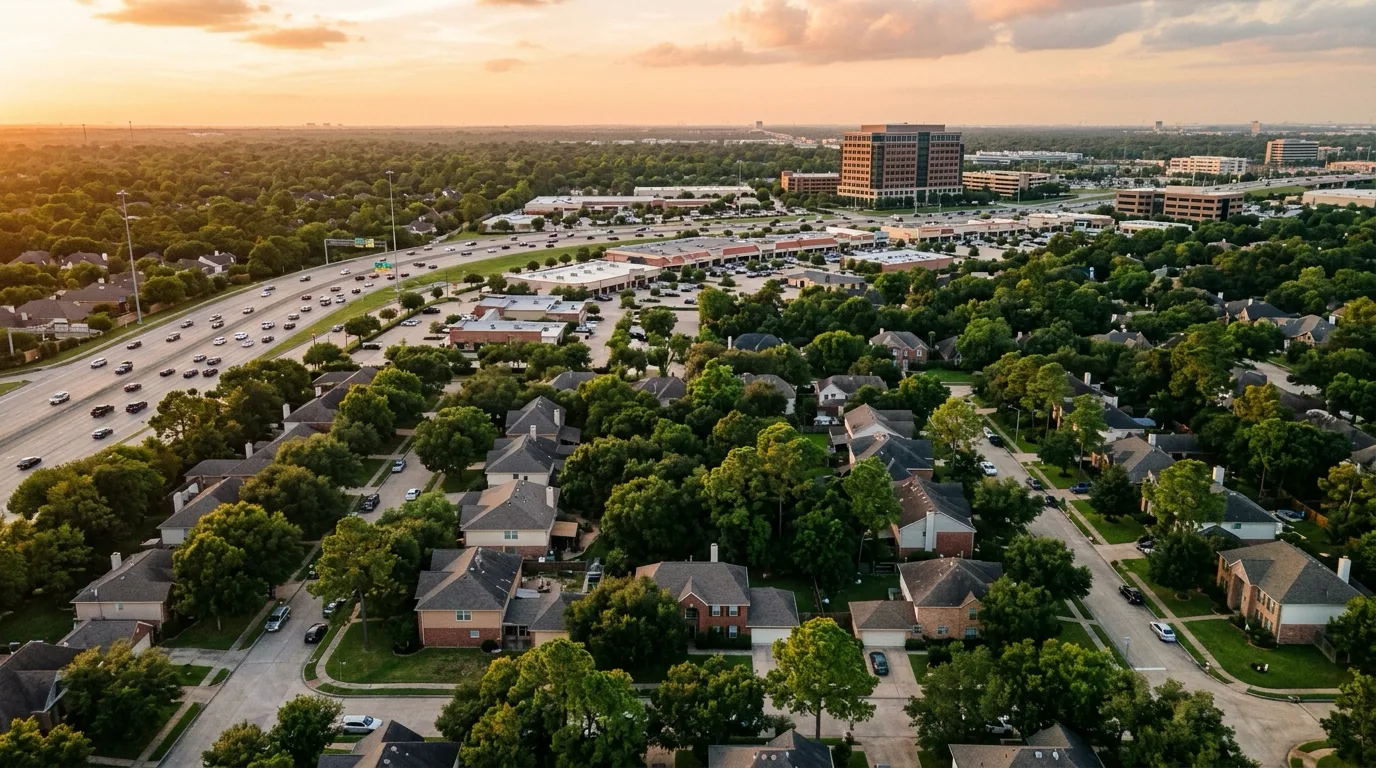
Houston has no zoning. In the City’s own words, “the City of Houston does not have zoning, but development is governed by ordinance codes that address how property can be subdivided,” so a residential street inside the city is protected by the deed restrictions recorded against it, which the City’s Legal Department can enforce in court, and by Chapter 42 rules on lot size and building lines. Cross a city limit and the answer changes. The six Memorial Villages and the City of Katy each have a zoning ordinance, and unincorporated county land has no land-use zoning at all. This guide explains each system and how to read the documents for one address.
This guide is written by Energy Realty, a west Houston brokerage with offices on Eldridge Parkway in the Energy Corridor and on Grand Circle Boulevard in Katy. It starts with the documents rather than the neighborhoods, because the documents decide what can be built. We quote the statute, ordinance or form behind each point and say where a Texas real estate attorney should take over.
Does Houston have zoning?
No. The Planning and Development Department states that “the City of Houston does not have zoning” and that “the City codes do not address land use.” Its Official City of Houston Zoning Letter, dated January 6, 2026, names only two exceptions: airport land use and height regulations around the city’s three airports, and Tax Increment Reinvestment Zone No. 1, St. George Place, where “zoning regulations control the use of land.” The letter adds that it “does not address any separately filed restrictions that may be applicable to a property.” Those separately filed restrictions are what decide what can be built next door.
Zoning in Houston takes a vote: Article VII-b, Section 13 of the City Charter, added in 1994, allows a zoning ordinance only after a six-month waiting period and “a binding referendum at a regularly scheduled election.” The department’s planning timeline, archived in December 2024, records a proposal that failed in 1929, an effort abandoned in 1937, citywide straw polls that went against zoning on November 2, 1948 and November 6, 1962, and a citywide referendum that rejected it on November 2, 1993. Houston relies instead on Chapter 42, deed restriction enforcement and separate ordinances for specific uses such as hazardous enterprises, hotels and towers.
Sources: City of Houston Planning and Development Department, Development Regulations, Official City of Houston Zoning Letter (January 6, 2026) and planning timeline (Internet Archive copy, December 8, 2024); City of Houston Charter, Article VII-b, Section 13. Retrieved October 12, 2026.
What no zoning means for a buyer
Without zoning, what a parcel may be used for is decided by whatever was recorded when the land was subdivided. The City Legal Department’s FAQ explains that there is no single set of restrictions for Houston, because “deed restrictions adhere to subdivision lines and sometimes section or even lot boundaries.” Two streets a block apart can carry different rules.
So can someone build a business next to your house? Inside Houston, it depends on the restrictions on that lot. If they limit it to residential use, owners, the association and the City can enforce that in court. If the lot is unrestricted, its restrictions have expired, or it was platted as a commercial or unrestricted reserve, a business can generally be built there, subject to the City’s development and use-specific ordinances. That is why the land around a subdivision, its reserves, vacant tracts and thoroughfare frontage, matters as much as the subdivision itself.
Sources: City of Houston Legal Department, Deed Restrictions FAQ. Retrieved October 12, 2026.
Who enforces deed restrictions in Houston?
Subchapter E of Chapter 212 of the Local Government Code lets a city of 1.5 million or more, or one without zoning, adopt an ordinance and then “sue in any court of competent jurisdiction to enjoin or abate a violation of a restriction” in a properly recorded plat or instrument. Houston’s ordinance is Article XV of Chapter 10 of its Code, and the City Legal Department’s Deed Restriction Enforcement Team takes complaints on a hotline, 832.393.6333, charges no fee, and sues for an injunction when the evidence supports it; under Section 10-552, an owner who fails to comply after notice faces civil penalties of up to $1,000 a day.
There are limits. The City may not sue if a property owners’ association with authority to enforce the restriction has filed its own suit, and it cannot enjoin a violation that began before August 30, 1965 and has not changed in nature.
One more rule matters to buyers. Section 10-556 requires each seller of restricted property in Houston to give the buyer a notice of the deed restrictions at closing, signed by both and recorded; a seller who fails commits a misdemeanor punishable by a fine of up to $500, though the failure does not affect the validity of the sale or the restrictions.
Sources: Texas Local Government Code Sections 212.151 to 212.156; City of Houston Code of Ordinances, Sections 10-551 to 10-556; City of Houston Legal Department, Deed Restrictions. Retrieved October 12, 2026.
Chapter 42: lot size, building lines and buffers
Chapter 42, the City’s land development ordinance, controls the shape of development, not its use. Inside the city, a single-family lot can be smaller than the 3,500-square-foot standard, down to an average of 1,400 square feet, if the plat meets the performance standards of Section 42-184. That is how one older lot can become several townhouse lots, unless deed restrictions or a special minimum lot size designation set a larger minimum. Building lines are floors, not ceilings: Section 42-150(b) provides that “where deed restrictions provide for a greater building line or setback, the deed restrictions shall control.”
Inside the city, the residential buffering standards apply when a new high-rise (more than 75 feet) takes access from a local or collector street, or a new mid-rise residential building (65 to 75 feet) takes access from a local street only, and the site abuts single-family or multi-unit residential property. They do not apply to development that fronts or takes access from a major thoroughfare or transit corridor street, or that sits in a designated major activity center. The City lists eight such centers, including MAC 2, Interstate 10 at Highway 6.
| Rule | Section | Standard |
|---|---|---|
| Minimum single-family lot with wastewater service, inside the city (smaller with compensating open space under 42-182, or under 42-184 below) | 42-181 | 3,500 sq ft |
| Minimum single-family lot with wastewater service, extraterritorial jurisdiction (smaller with compensating open space under 42-182) | 42-181 | 5,000 sq ft |
| Smaller lots inside the city, minimum average under the 42-184 performance standards (up to 27 units per gross acre) | 42-184 | 1,400 sq ft |
| Building line, major thoroughfare (Chapter 42 allows less in set cases, such as 10 ft where a single-family lot backs onto it with plat notes) | 42-152 | 25 ft |
| Building line, front of a single-family lot on a local street (10 ft with plat notes; 20 ft for a street-facing garage) | 42-156 | 20 ft |
| Buffer, high-rise next to homes, on a collector street | 42-272 | 30 ft |
| Buffer, high-rise next to homes, on local streets only | 42-272 | 40 ft |
| Buffer, mid-rise residential next to homes, on a local street only (none under 65 ft) | 42-272 | 15 ft |
Sources: City of Houston Code of Ordinances, Sections 42-1, 42-150, 42-152, 42-156, 42-181, 42-182, 42-184, 42-271 and 42-272; City of Houston, Residential Buffering Ordinance. Retrieved October 12, 2026.
Special minimum lot size and building line designations
A Houston neighborhood whose deed restrictions set no lot size or setback can add one. The Planning and Development Department calls Special Minimum Lot Size and Special Minimum Building Line “neighborhood-initiated tools.” A block designation, for lot size or building line, covers one blockface or two opposing blockfaces, at least 60 percent single-family, with at least one lot lacking a deed-restricted minimum; a lot size area designation needs at least five blockfaces of five or more lots, at least 80 percent single-family, with at least 10 percent of lots lacking a deed-restricted minimum. The minimum is the lot size, or front setback, already met by at least 70 percent of the application area, or 60 percent in a City-designated historic district. For a block, owners get 30 days to protest; a protest sends the application to a Planning Commission hearing, a Commission denial is final, and otherwise City Council decides. Existing smaller lots and homes may stay; the rule governs future subdivision and new construction.
A lot size designation from an application completed after May 24, 2013 runs 40 years, and earlier ones run 20. Renewing a lot size block adds 20 years, and renewal applications are accepted no earlier than two years before expiration. If a designation is not renewed, the City warns, it “will no longer apply to the block after the expiration date.” Search the address on the department’s GIS map first.
Sources: City of Houston Planning and Development Department, Special Minimum Lot Size and Special Minimum Building Line Program and 2026 application packets; City of Houston Code of Ordinances, Sections 42-170, 42-197 and 42-207. Retrieved October 12, 2026.
Next door, the opposite answer: the Memorial Villages and the City of Katy are zoned
The six Memorial Villages are separate incorporated cities, and each has a zoning ordinance in its code. Memorial West, west of the Villages to State Highway 6, is inside the City of Houston and has no zoning. Our Memorial guide explains where the lines run.
| City | Where the zoning is codified | Districts |
|---|---|---|
| Hunters Creek Village | Chapter 44, Zoning | District R single-family residential and District B business; District R lots at least 22,500 square feet |
| Piney Point Village | Chapter 74, Zoning | The whole city is one single-family residential district |
| Bunker Hill Village | Appendix A, Zoning | Two single-family residential districts, A and B |
| Hedwig Village | Appendix A, Planning and Zoning Code | Residential districts A and C; business districts B-1 to B-4 |
| Hilshire Village | Chapter 12, zoning ordinance first adopted March 17, 1964 | Single-family dwelling districts R-1 to R-4 and commercial districts C-1 and C-2 |
| Spring Valley Village | Chapter 12, districts restated by Ordinance 2008-11 | Dwelling District A, Office Building District B, Commercial District C and planned area development districts |
Village zoning also reaches short-term rentals: Hunters Creek Village, Piney Point Village and Bunker Hill Village each prohibit renting a single-family home for less than 30 consecutive days, with narrow exceptions such as a seller’s leaseback. Inside Houston, a short-term rental must register with the City under Chapter 28, Article XXIII, in effect since January 1, 2026, and the owner must acknowledge that the rental does not violate the property’s deed restrictions; whether one is allowed on a street still turns on those restrictions.
The City of Katy is zoned too. Ordinance 621, adopted March 24, 1983 and amended since, divides the city into residential, commercial, general business, industrial, planned development, mobile home and “Old Katy” districts shown on the City’s zoning maps and adds a master planned community district. But much of what people call Katy is outside the city: the City of Katy covers 15.3 square miles in the Census Bureau’s 2024 Gazetteer, while Katy ISD covers 181. Our Katy guide explains the difference.
Sources: Codes of Ordinances of the six Villages and the City of Katy (Chapter 14 and Exhibit 14A), as published by Municode; City of Houston Code of Ordinances, Sections 28-722 and 28-731; City of Houston, Super Neighborhood 16; U.S. Census Bureau, 2024 Gazetteer; Katy ISD. Retrieved October 12, 2026.
Unincorporated Harris and Fort Bend County: no zoning at all
Texas counties have no general zoning power. The Texas A&M Real Estate Research Center puts it plainly: “Texas counties have limited land-use regulation authority, which does not include zoning but does include platting,” and platting rules outside city limits “may not affect use or residential density.” In an unincorporated Katy-area subdivision, other things govern land use.
- Recorded restrictions and the property owners association, often controlled by the developer at first and by owners later.
- County subdivision rules: the Regulations of Harris County, Texas for the Approval and Acceptance of Infrastructure, and the Fort Bend County Regulations of Subdivisions, adopted August 27, 2002. They govern platting, roads and drainage, not use.
- City platting review in an extraterritorial jurisdiction. Local Government Code Section 212.003 bars a city from regulating there “the use of any building or property,” building bulk or height, or units per acre.
- Floodplain rules, which our flood guide covers, and the municipal utility district, which builds the water, sewer and drainage system and taxes for it but does not regulate land use; our MUD guide covers the tax side.
Outside a city, the recorded restrictions are the only thing that says a lot must stay residential.
Sources: Texas A&M Real Estate Research Center, What You Need to Know About Land-Use Restrictions in Texas (Winter 2025); Texas Local Government Code Section 212.003; Harris County Office of the County Engineer, Platting; Fort Bend County Engineering, Regulations of Subdivisions. Retrieved October 12, 2026.
Four places, four answers
| City of Houston (much of the Energy Corridor District, Memorial West) | A Memorial Village | City of Katy | Unincorporated Katy area | |
|---|---|---|---|---|
| Who sets land-use rules | City Council through Chapter 42 and use-specific ordinances | The Village’s city council through its zoning ordinance | Katy City Council through Ordinance 621 | No city; the county for platting, roads and drainage |
| Zoning | No | Yes | Yes | No |
| What protects a residential street | Recorded deed restrictions, enforceable by owners, the association and the City; Chapter 42; special minimum lot size or building line designations | The zoning district, plus any recorded restrictions | The zoning district, plus any recorded restrictions | Recorded restrictions and the property owners association |
| Where to look it up | County clerk records; the plat; the City’s special minimum lot size and building line map | The Village’s code and zoning map; county clerk records | The City of Katy code and zoning maps; county clerk records | County clerk records; the association’s resale certificate |
Sources: as cited in the sections above. Retrieved October 12, 2026.
The Energy Corridor: planned, not zoned
The Energy Corridor District is Harris County Improvement District No. 4, a municipal management district whose stated mission is to “promote, develop, maintain, and enhance” the district through projects in areas including mobility, streetscape and economic development. It plans and invests; it does not decide what may be built on a lot. Much of it lies inside Houston’s city limits, where the City’s rules apply. Its residential sections are protected by their own deed restrictions and associations, so those are the documents to read. Our Energy Corridor guide covers the neighborhoods themselves.
Sources: Energy Corridor District, About; City of Houston Chapter 380 agreement with Harris County Improvement District No. 4; Texas Special District Local Laws Code, Chapter 3814; City of Houston, Super Neighborhood 17. Retrieved October 12, 2026.
How to find and read the deed restrictions for one address
- Get the legal description, meaning the subdivision, section, block and lot, from the appraisal district record.
- Search the county clerk’s records: the Harris County Clerk’s Real Property search, or the Fort Bend County Clerk’s Official Public Records. Pull the plat, the restrictions for your section and every amendment or extension.
- Read the title commitment. Under paragraph 6 of TREC’s resale contract, form 20-19, effective July 1, 2026, the title policy is subject to “restrictive covenants common to the platted subdivision in which the Property is located,” and within 20 days after the title company receives the contract the seller must furnish the commitment and, at the buyer’s expense, “legible copies of restrictive covenants.”
- Use paragraph 6D. A buyer may object to title exceptions, including those “which prohibit the following use or activity,” with a blank to fill in. If you plan a pool, a garage apartment or a home office that receives clients, name it there.
- If there is an association, get the subdivision information. Property Code Section 207.003 requires it, within 10 business days of a written request, to deliver the restrictions, bylaws, rules and a resale certificate listing assessments, pending lawsuits and known violations on the property, for a fee of up to $375. Under TREC’s HOA addendum, form 36-11, if the seller delivers it or the buyer obtains it under the addendum, the buyer may terminate within 3 days after receiving it or before closing, whichever comes first.
- Read the seller’s disclosure. TREC form 55-1 asks whether the seller is aware of “any notices of violations of deed restrictions or governmental ordinances affecting the condition or use of the Property.”
Property Code Section 5.026 voids any restriction barring use, sale, lease or transfer “because of race, color, religion, or national origin,” language some older restrictions still contain.
Real estate licensees may not practice law. If the restrictions have been amended several times, an expiration date is unclear, or your plans depend on a use they may limit, have a Texas real estate attorney read them during your option period.
Sources: Harris County Clerk; Fort Bend County Clerk; Texas Real Estate Commission, forms 20-19, 36-11 and 55-1; Texas Property Code Sections 5.026 and 207.003; Texas A&M Real Estate Research Center. Retrieved October 12, 2026.
Can deed restrictions expire, and how are they renewed?
Yes. Restrictions run for the term the recorded instrument sets, and some lapse. In Chapter 201 of the Property Code the Legislature found that “the pending expiration of property restrictions” in cities and their extraterritorial jurisdictions “where there is no zoning creates uncertainty in living conditions.”
- Chapter 201 reaches subdivisions in Houston, in unincorporated Harris County and in Fort Bend County, unless the restrictions set their own qualifying renewal terms. A petition can extend, renew or create restrictions with signatures from owners of a majority of the lots, and modify or add to them with 75 percent. Each extension period may run up to 10 years. Owners who do not sign can keep their lots out by filing a statement within a year of actual notice of the petition, so a renewed section can still contain unrenewed lots.
- Chapter 204 applies in a county of 3.3 million or more, which includes Harris County, at 5,009,302 residents in the Census Bureau’s 2024 estimate. There an association may extend or modify restrictions with approval from owners of at least 75 percent of the real property, but a percentage set in the restrictions themselves prevails. Fort Bend County, at 958,434, is below that threshold.
Sources: Texas Property Code Sections 201.001, 201.002, 201.004, 201.005, 201.006, 201.009, 204.002, 204.003 and 204.005; U.S. Census Bureau, Vintage 2024 county population estimates. Retrieved October 12, 2026.
A buyer’s checklist for one street
- Read the plat for everything around the lot. Under Section 42-190, a tract “not restricted to single-family residential use” must be platted as a reserve, and one with no determined use is labeled an unrestricted reserve. Ask the same of every vacant tract nearby.
- Check major thoroughfare frontage, where a 25-foot building line generally applies and the residential buffering standards do not.
- Find the expiration dates of the restrictions, any extension and any special minimum lot size or building line designation.
- In a Village or the City of Katy, look up the zoning district of the lots around you, not just your own.
- In an unincorporated subdivision, read how the declaration is amended and who controls the association today.
Selling instead? See our guide to selling a home in the Energy Corridor, Memorial or Katy. Still choosing? Our comparison of the Energy Corridor, Memorial and Katy sets the three side by side.
Sources: City of Houston Code of Ordinances, Sections 42-152, 42-190 and 42-271. Retrieved October 12, 2026.
Frequently Asked Questions
Does Houston have zoning?
No. The City of Houston has no citywide zoning ordinance; its codes govern how property is subdivided, chiefly through Chapter 42, not how land is used. The City’s January 6, 2026 zoning letter lists only two exceptions, land around the airports and Tax Increment Reinvestment Zone No. 1, St. George Place. Recorded deed restrictions do the work zoning does elsewhere.
What does Houston having no zoning mean for a homebuyer?
It means no city map says what each parcel may be used for. Inside Houston, a residential street is protected by its recorded deed restrictions, which follow subdivision and sometimes section lines, and by Chapter 42 rules on lot size and building lines. Before buying, read your section’s restrictions and look at the reserves, vacant tracts and thoroughfare frontage nearby.
Can someone build a business next to my house in Houston?
Inside the City of Houston it depends on the recorded restrictions on that lot, not on zoning. If they limit the lot to residential use, the City’s Legal Department, the association or neighbors can sue to stop a business. If the lot is unrestricted, its restrictions have expired, or it was platted as a commercial or unrestricted reserve, a business can generally be built there, subject to the City’s development and use-specific ordinances.
How do I find the deed restrictions for a Houston property?
Get the subdivision, section, block and lot from the appraisal district, then search the Harris County Clerk’s Real Property records or the Fort Bend County Clerk’s Official Public Records. In a purchase, paragraph 6B of TREC form 20-19 requires the seller to furnish the title commitment and, at the buyer’s expense, copies of the restrictive covenants within 20 days after the title company receives the contract, a deadline that can extend by up to 15 days.
Who enforces deed restrictions in Houston?
Owners in the subdivision and the property owners association can sue, and so can the City. Under Local Government Code Chapter 212, Subchapter E, the City Legal Department’s Deed Restriction Enforcement Team takes complaints on its hotline at 832.393.6333, charges no fee and sues for injunctions. The City may not sue if the association has already filed its own suit.
Do the Memorial Villages have zoning?
Yes. Each of the six Villages is a separate city with a zoning ordinance: Hunters Creek Village, Piney Point Village, Bunker Hill Village, Hedwig Village, Hilshire Village and Spring Valley Village. Memorial West, west of the Villages, is inside the City of Houston and has no zoning.
Does Katy have zoning?
The City of Katy does. Its zoning ordinance, Ordinance 621, was adopted on March 24, 1983 and, as amended, sets residential, commercial, general business, industrial, planned development, mobile home, Old Katy and master planned community districts. Much of the Katy area, however, lies outside the city limits, and on unincorporated county land there is no zoning; recorded restrictions and associations govern use.
Is there zoning in unincorporated Harris County or Fort Bend County?
No. The Texas A&M Real Estate Research Center explains that Texas counties have limited land-use authority that does not include zoning, though they regulate platting, and that platting rules outside city limits may not affect use or residential density. Local Government Code Section 212.003 also bars a city from regulating use in its extraterritorial jurisdiction.
Can deed restrictions expire?
Yes. Restrictions last for the term the recorded instrument sets, and some lapse. Under Property Code Chapter 201, owners of a majority of the lots can sign a petition to extend or renew them for periods of up to 10 years, and in Harris County, Chapter 204 lets an association extend or modify them with approval from owners of 75 percent of the property, unless the restrictions set their own percentage.
Does the Energy Corridor have zoning?
No. The Energy Corridor District is a municipal management district that works on mobility, streetscape and economic development; it does not regulate what is built on a lot. Much of it lies inside the City of Houston, which has no zoning, so homes there are protected by their subdivisions’ deed restrictions and associations and by Chapter 42.
Keep reading
Looking at a street and want to know what its documents allow?
Send us the address. Our agents can help you request the plat, the recorded restrictions and, for a Village or City of Katy address, the zoning map, and point out the questions a Texas real estate attorney should answer during your option period. Energy Realty works from offices on Eldridge Parkway in the Energy Corridor and on Grand Circle Boulevard in Katy.
Ask Energy Realty about a street
Social Cookies
Social Cookies are used to enable you to share pages and content you find interesting throughout the website through third-party social networking or other websites (including, potentially for advertising purposes related to social networking).