
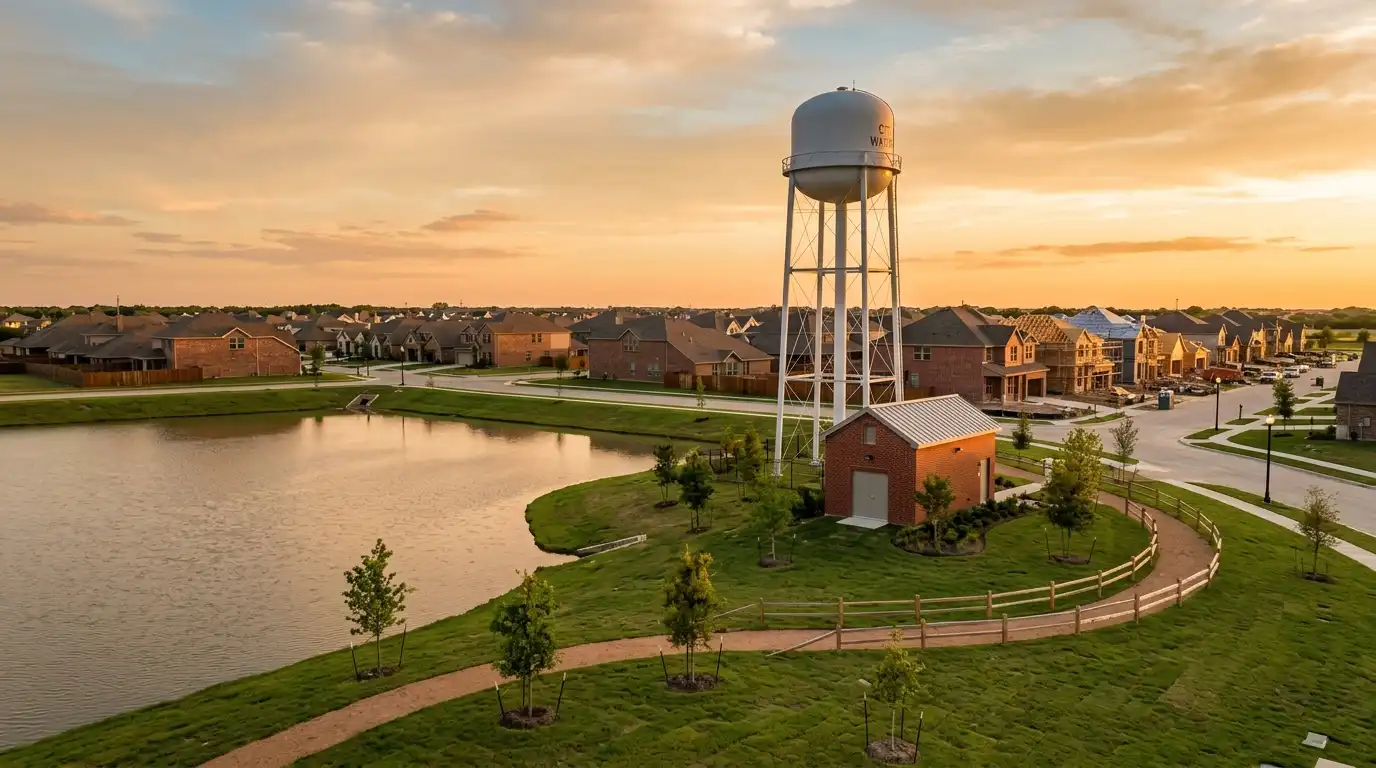
A municipal utility district, or MUD, is a small local government created under the Texas Water Code that borrowed money to build a subdivision’s water, sewer and drainage system and repays that debt with its own property tax. It is the reason two nearly identical homes a few miles apart in Katy can carry total tax rates of 2.0 percent and 3.2 percent of value. Texas has no state income tax, so a property tax bill here is a stack of separate rates from separate governments, and the utility district is the line that varies most. This guide explains the stack, shows the real 2025 rates for the taxing units in west Houston, works three Katy-area examples, and covers the notice a seller must hand you, the homestead exemption and how to protest.
It is written by Energy Realty, whose Katy office sits in the middle of the most district-dense real estate market in Texas and whose agents read a district notice at nearly every closing. We do not tell clients that a neighborhood is “high tax” or “low tax.” We add up the lines. Every rate on this page carries its tax year and source.
Why a Texas property tax bill is a stack, not a number
Article VIII, Section 24-a of the Texas Constitution prohibits the Legislature from imposing a tax on the net incomes of individuals. What income tax funds in most states, property tax funds here, and it is levied not by one government but by every local government whose boundary contains the parcel. Each of those taxing units adopts its own rate each fall, expressed per $100 of appraised value, and the county tax office collects them together. The bill you receive is the sum.
In west Houston the units are, in the usual order of size:
- The school district. The largest line everywhere. For 2025, Katy ISD adopted 1.1171 per $100, Spring Branch ISD 1.0231, Houston ISD 0.8783, Cypress-Fairbanks ISD 1.0669, Fort Bend ISD 1.0569 and Lamar CISD 1.1469. School rates have been falling under the state’s compression program: Katy ISD’s was 1.3048 in 2022.
- The county and its districts. In Harris County for 2025: the county at 0.38096, the Harris County Flood Control District at 0.04966, the Port of Houston Authority at 0.00590, Harris Health (the hospital district) at 0.18761 and the Harris County Department of Education at 0.004798, together about 0.629. In Fort Bend County: the county at 0.412 plus the Fort Bend County Drainage District at 0.010, together 0.422.
- A city, or a utility district. Inside a city, the city’s rate: the City of Houston at 0.519190 and the City of Katy at 0.425 for 2025, and the six Memorial Villages from 0.205164 (Hunters Creek) to 0.529226 (Hilshire). Outside a city, the municipal utility district that built the subdivision, at anything from about 0.22 in a mature Katy-area district to 1.72 at the 2025 county maximum.
- The rest. An emergency services district in unincorporated areas, a community college district, sometimes a levee improvement district or a drainage district such as Willow Fork Drainage District at 0.145 in the Cinco Ranch area.
Add the lines that apply to the parcel and you have its rate. That is the whole method, and it is why “what is the property tax rate in Katy” has no single answer.
Sources: Texas Constitution, Article VIII, Section 24-a; Harris County Tax Assessor-Collector, 2025 Truth in Taxation summary and jurisdiction tax rates (including the Harris County Department of Education rate); Harris Central Appraisal District jurisdiction list; Fort Bend County 2025 tax rate and exemption worksheet; Katy ISD board action, September 22, 2025; Houston ISD board action, October 15, 2025; Cypress-Fairbanks ISD board action, October 28, 2025. Retrieved August 24, 2026.
What a MUD actually is
The Texas Commission on Environmental Quality, which supervises water districts, defines a municipal utility district as “one that is formed under specific circumstances to provide utility services to a designated area,” governed by Chapter 54 of the Texas Water Code and the agency’s rules in 30 TAC Chapter 293. A water district more generally is “a local, governmental entity that provides limited services to its customers and residents.”
Here is how one comes to exist. A developer assembles land outside a city’s limits, where no city will extend water and sewer. Under Water Code Section 54.014, a petition to create the district, signed by a majority in value of the landowners, is filed with the TCEQ (some districts are created by the Legislature instead). The district is governed, under Section 54.101, by a board of five directors, who must own taxable land in the district or be qualified voters within it. The board authorizes bonds, and the district sells them to reimburse the developer for the water plant, the sewer lines, the storm drainage, the detention ponds and, in some districts, parks, roads and streetlights. The district then levies a property tax on every home inside its boundary to repay the bonds and to operate the system. As the bonds are retired and the tax base grows, the rate typically falls.
Cinco Ranch is the clearest illustration in west Houston. The Cinco Residential Property Association explains that a MUD “typically provides potable water, sanitary sewer service, and storm sewer service” and may add trash collection, parks, streetlights and security, that each district has an elected five-member board, and that Cinco Ranch is served by Cinco MUDs 1 through 14, Fort Bend County MUD 35 and Cornerstones MUD. One master-planned community, sixteen governments.
The scale of the system explains why newcomers find it bewildering. The Texas Commission on Environmental Quality’s water district database listed 1,558 active municipal utility districts statewide on August 24, 2026, including 460 in Harris County and 207 in Fort Bend County. On the Harris County Tax Office’s 2025 rate list, 38 districts levied $1.00 or more per $100 and the highest was 1.72.
Sources: Texas Water Code Chapter 54 (Sections 54.011, 54.012, 54.014, 54.101, 54.501, 54.601); Texas Commission on Environmental Quality, municipal utility districts page and the TCEQ Water Districts dataset (data.texas.gov, hr84-s96f, active districts queried August 24, 2026); Cinco Residential Property Association; Harris County Tax Assessor-Collector, 2025 jurisdiction tax rates. Retrieved August 24, 2026.
Three Katy-area tax stacks, worked with 2025 rates
The examples below use adopted 2025 rates from the county tax offices and the school district. They exclude emergency services districts and community college districts, which are address-specific, so treat each total as a floor.
| Line | A. Unincorporated Fort Bend, Katy ISD, Cinco MUD 9, Willow Fork DD | B. Inside the City of Katy (Fort Bend County side), Katy ISD, no MUD | C. Unincorporated Harris, Katy ISD, Nottingham Country MUD |
|---|---|---|---|
| County | 0.412000 | 0.412000 | 0.380960 |
| County drainage / flood control | 0.010000 | 0.010000 | 0.049660 |
| Port of Houston | none | none | 0.005900 |
| Harris Health | none | none | 0.187610 |
| Harris County Dept. of Education | none | none | 0.004798 |
| Katy ISD | 1.117100 | 1.117100 | 1.117100 |
| City | none | 0.425000 | none |
| Utility district | 0.294200 | none | 0.249900 |
| Drainage district | 0.145000 | none | none |
| Total | 1.978300 | 1.964100 | 1.995928 |
| On $500,000, no exemptions | $9,891.50 | $9,820.50 | $9,979.64 |
Column B models the Fort Bend side of the city, which straddles three counties; on the Harris County side the same configuration totals about 2.17. Notice that all three land within about 0.03 of each other. That is because all three use mature districts or no district at all. Now change one line. Replace Nottingham Country MUD in column C with a young Harris County district still carrying its construction debt, for example Harris County MUD 542 at 1.07 per $100 in 2025, and column C becomes about 2.82 per $100, or roughly $14,100 a year on the same $500,000 home. The county-wide maximum on the 2025 list, 1.72 in a district outside the Katy area, would take the same stack to about 3.47, or roughly $17,300. On the Fort Bend side, Fort Bend County MUD 162, created in 2005, levied 1.10 in 2025, and MUDs 134B, 134C and 155 levied between 0.86 and 0.965. For the Katy example, same school district, same county, same commute. The utility district is the whole difference, and it is a difference of $4,000 to $7,000 a year for the life of the district’s bonds.
Katy-area and west Houston districts with 2025 rates in the county tables, for reference: Cinco MUD 2 at 0.22, Cinco MUD 3 at 0.232, Cinco MUD 6 at 0.2454, Cinco MUD 7 at 0.2242, Cinco MUD 5 at 0.30, Cinco MUD 9 at 0.2942, Nottingham Country MUD at 0.2499, Harris County MUD 81 at 0.25, Memorial MUD at 0.28, Mason Creek UD at 0.351, Harris County MUD 238 at 0.39, Harris County MUD 61 at 0.43, Harris County MUD 239 at 0.52, Harris County MUD 105 at 0.61, Harris County MUD 419 at 0.79, Harris County MUD 165 at 0.82 and Harris County MUD 542 at 1.07. Fort Bend MUD 129 was the lowest the Fort Bend tax office collected for at 0.18 and Fort Bend MUD 162 the highest at 1.10. A rate tells you what a district charges, not which subdivision it serves; the appraisal district’s jurisdiction list for the parcel tells you that.
Sources: Fort Bend County Tax Assessor-Collector, 2025 tax rate and exemption worksheet; Harris County Tax Assessor-Collector, 2025 tax rates; Fort Bend Central Appraisal District, tax rates; Katy ISD board action, September 22, 2025. Totals are simple sums of the listed 2025 rates per $100 of taxable value, before any exemption; emergency services and college districts are excluded, and none of the stacks is a specific address’s bill. Retrieved August 24, 2026.
The notice a seller must give you, and what to do with it
Texas does not leave the district to be discovered on the first tax bill. Water Code Section 49.452 provides that “a person who proposes to sell or convey real property located in a district must give to the purchaser the written notice” the statute prescribes, and that the notice must be given “prior to execution of a binding contract of sale and purchase.” If it is not, the purchaser may terminate the contract, and the statute provides damages remedies and a limitations period for bringing them.
The statute also provides for the notice to be signed by the buyer and recorded with the deed at closing, which is why you will see it twice. Section 49.4521, added in 2023, prescribes what the notice says. It must state the district’s current property tax rate on each $100 of assessed valuation, the total amounts of bonds approved by the voters for water, sewer and drainage and for other facilities, the amount of any standby fee, and the purpose of the district.
Look at the rate and multiply it by the home’s value divided by 100; that is the district’s annual charge. Look at the bonds authorized against the bonds issued; a large unissued authorization means the rate can rise before it falls. Look at the standby fee, which applies to undeveloped lots. Then ask the district’s website or the county’s rate table for the last five years of rates, which tells you the direction. A district at 0.29 that was 0.45 five years ago is doing what districts are supposed to do. A district at 1.07 in year two is doing the same thing, earlier in the cycle, and the buyer is paying for the pipes.
Sources: Texas Water Code Sections 49.452 and 49.4521 (as amended by HB 2815 and HB 2816, 88th Legislature, 2023). Retrieved August 24, 2026.
Cities, ESDs, LIDs and PIDs: the other lines
Cities. Inside a city there is usually no MUD, because the city provides what the district exists to build, and the city levies its own tax instead. In 2025 the City of Katy levied 0.425 and the City of Houston 0.519190. The six Memorial Villages, which are separate cities, levied from 0.205164 in Hunters Creek to 0.529226 in Hilshire. Living in a city is not automatically cheaper than living in a district; it is a different line. Exceptions exist where a district predates an annexation or sits in a city’s extraterritorial jurisdiction, so check the jurisdiction list for the address.
Emergency services districts. Unincorporated areas fund fire and emergency medical service through ESDs, created under Chapter 775 of the Health and Safety Code, whose boards must impose an annual property tax and may add a sales tax by election. Their rates are small and address-specific, which is why the example stacks above are floors. The county’s rate table lists them by number.
College districts. Depending on the address, the community college line is Houston City College (still listed on tax bills as Houston Community College) at 0.098802 per $100 for 2025 or the Lone Star College System at 0.1060. Whether a Katy parcel is inside either is a jurisdiction-list question.
Levee improvement districts. Common in Fort Bend County, where a subdivision behind a levee is served by a district that builds and maintains the levee and drainage and levies a tax for it. Like a MUD, it appears on the seller’s district notice.
Public improvement districts. Created by a city or county under Chapter 372 of the Local Government Code, the Public Improvement District Assessment Act, rather than under the Water Code, a PID levies an assessment apportioned by the city or county for improvements that benefit a defined area, such as landscaping, lighting, sidewalks and streets. It is not a self-governing district with its own bonds and tax, it is not a MUD, and it is not always on the same documents; ask.
The homestead exemption, the 10 percent cap and the protest
Three mechanisms lower the bill on a primary residence, and all three require the owner to act.
The homestead exemption. Texas Tax Code Section 11.13(b) requires school districts to provide a $140,000 exemption on a residence homestead, raised from $100,000 by the constitutional amendment voters approved on November 4, 2025 (Senate Joint Resolution 2, enabled by Senate Bill 4). Section 11.13(c) requires an additional $60,000 school exemption for owners 65 or older or disabled. Section 11.13(n) allows any taxing unit to adopt a local option exemption of up to 20 percent of appraised value; Fort Bend County, for example, offers 20 percent or $5,000, whichever is greater. The general filing deadline is before May 1, on Comptroller Form 50-114, with the appraisal district. On a $500,000 Katy ISD home the school exemption alone removes $140,000 from the school line, saving about $1,564 a year at the 2025 rate. The exemption applies only to the owner’s principal residence, which means a relocated owner who leases the home out loses it.
The 10 percent cap. Under Tax Code Section 23.23, the appraised value of a home that qualified for the homestead exemption in both the preceding and current year “may not increase more than 10 percent per year,” regardless of market value. The cap takes effect on January 1 of the year after the owner qualifies and expires on January 1 of the year after the owner no longer qualifies. A buyer does not inherit the seller’s capped value; the appraisal resets to market in the year after purchase, which is why a new owner’s first full-year bill is often higher than the seller’s last one. A separate, temporary 20 percent cap under Section 23.231 applies to non-homestead property below an indexed value ceiling; it expires December 31, 2026 and should not be relied on for a rental or second home beyond that.
The protest. Each spring the appraisal district mails a notice of appraised value, and any owner may protest it to the appraisal review board by the deadline on the notice, generally May 15 or 30 days after delivery, whichever is later. In Harris County the Harris Central Appraisal District takes protests through its iFile system; in Fort Bend County, the Fort Bend Central Appraisal District. The owner presents comparable sales, condition and repair evidence, informally with an appraiser or at a hearing. Protesting is routine in Texas rather than adversarial, and Energy Realty helps clients assemble the comparable sales for it every year.
Sources: Texas Comptroller of Public Accounts, property tax exemptions and valuing property pages; Texas Legislature Online, SJR 2 and SB 4, 89th Legislature; Fort Bend County 2025 tax rate and exemption worksheet; Harris Central Appraisal District; Fort Bend Central Appraisal District. Retrieved August 24, 2026.
What this means when you are choosing between two houses
- Get the jurisdiction list for each address from the appraisal district before you fall in love with either. Harris or Fort Bend, city or district, which ISD, which ESD.
- Read the seller’s district notice for the MUD rate and the bonds outstanding, and pull five years of the district’s rate history.
- Add the lines. Compare totals, not the school district’s reputation or the city’s name.
- Model the first full year after purchase at market value, not the seller’s capped value, and subtract the homestead exemption only if you will live there.
- Remember that a new district’s high rate is buying infrastructure that will be paid off, and a mature district’s low rate is the result of someone else having paid for it. Neither is a mistake. They are different prices for the same house over a different number of years.
Frequently Asked Questions
What is a MUD in Texas?
A municipal utility district is a local government created under Chapter 54 of the Texas Water Code, which the Texas Commission on Environmental Quality describes as a district formed under specific circumstances to provide utility services to a designated area. In practice, a developer building a subdivision outside a city’s limits creates a MUD, the district sells bonds to build the water, sewer, drainage and sometimes park and road systems, and it repays those bonds by levying its own property tax on the homes in the district, governed by a board elected by the residents.
Why is my Katy property tax rate 3 percent when my friend’s is 2 percent?
Almost always because of the utility district. Everyone in Katy ISD pays the district’s 1.1171 per $100 of value for 2025 and the same county-level lines, so the swing between two homes is the MUD. A mature district that has paid down its bonds levied around 0.23 to 0.30 in 2025, for example Cinco MUD 3 at 0.232 and Cinco MUD 9 at 0.2942, while young districts still carrying their construction debt levied 1.00 or more (Harris County MUD 542 at 1.07, Fort Bend County MUD 162 at 1.10, and the highest Harris County district at 1.72). That difference alone moves a total rate from about 2.0 to between 2.8 and 3.5 per $100, which on a $500,000 home is roughly $4,000 to $7,000 a year.
What taxing units make up a west Houston property tax bill?
In Harris County for 2025: the county at 0.38096 per $100, the Harris County Flood Control District at 0.04966, the Port of Houston Authority at 0.00590, Harris Health at 0.18761 and the Harris County Department of Education at 0.004798, plus the school district (Katy ISD 1.1171, Spring Branch ISD 1.0231, Houston ISD 0.8783), plus either a city (City of Houston 0.519190, City of Katy 0.425) or a municipal utility district, plus in some areas an emergency services district and a community college district. In Fort Bend County the county line is 0.412 plus a 0.010 drainage district in place of the Harris County lines.
Does a seller have to tell me about the MUD before I buy?
Yes. Texas Water Code Section 49.452 requires a person who proposes to sell real property located in a district to give the purchaser a written notice before a binding contract of sale is signed. Section 49.4521 prescribes the notice’s contents, including the district’s current property tax rate per $100 of assessed valuation, the total bonds approved by voters for water, sewer and drainage and other facilities, any standby fee and the district’s purpose. If the notice is not timely given, the purchaser may terminate the contract, and the statute provides damages remedies.
Do MUD taxes go down over time?
Generally yes, as the district retires the bonds that built the subdivision, though the timing depends on the district’s debt schedule, whether it issues new bonds for additional facilities, and how fast the tax base grows. The Katy area shows the pattern: the older Cinco Ranch districts levied 0.22 to 0.30 per $100 in 2025 while districts still building out levied 1.00 or more, up to 1.72 in Harris County. The seller’s district notice states the bonds outstanding, and the district’s own website usually publishes its debt schedule and rate history.
What is the Texas homestead exemption in 2026?
For school district taxes, Texas Tax Code Section 11.13(b) now requires a $140,000 exemption on a residence homestead, raised from $100,000 by the constitutional amendment voters approved on November 4, 2025. Homeowners who are 65 or older or disabled receive an additional $60,000 school exemption under Section 11.13(c). Other taxing units may adopt a local option exemption of up to 20 percent of appraised value. The general application deadline is before May 1, using Comptroller Form 50-114 filed with the appraisal district, and the exemption applies only to the owner’s principal residence.
What is the 10 percent homestead cap?
Under Texas Tax Code Section 23.23, the appraised value of a home that qualified for the homestead exemption in both the preceding and current year may not increase more than 10 percent per year for tax purposes, regardless of how much its market value rises. The cap takes effect on January 1 of the tax year after the owner qualifies for the exemption and expires on January 1 of the year after the owner no longer qualifies. A new buyer does not inherit the seller’s capped value; the appraisal resets to market value in the year after purchase.
How do I protest my property appraisal in Harris or Fort Bend County?
Each spring the appraisal district mails a notice of appraised value. An owner who believes the value is too high files a protest with the appraisal review board, in Harris County through the Harris Central Appraisal District’s online iFile system and in Fort Bend County through the Fort Bend Central Appraisal District, by the deadline stated on the notice, generally May 15 or 30 days after the notice is delivered, whichever is later. The owner presents evidence such as comparable sales, condition and repair estimates, either informally with an appraiser or at a hearing. Protesting is routine in Texas, not adversarial, and Energy Realty helps clients assemble comparable sales for it.
Is there a MUD inside the City of Katy or the City of Houston?
Usually not, because a city provides the water, sewer and drainage that a MUD exists to build, and the city levies its own tax instead: the City of Katy at 0.425 per $100 in 2025 and the City of Houston at 0.519190. MUDs are the mechanism for subdivisions in unincorporated county land. There are exceptions where a district predates annexation or a city allows a district within its extraterritorial jurisdiction, so check the seller’s notice and the appraisal district’s jurisdiction list for any specific address.
What is the difference between a MUD, a PID and a LID?
A municipal utility district is a water district that levies a property tax to repay bonds for water, sewer and drainage. A levee improvement district, common in Fort Bend County, is a water district that builds and maintains levees and drainage and also levies a property tax. A public improvement district is created by a city or county rather than under the Water Code and levies an assessment rather than a tax, typically for amenities or infrastructure in a defined area. All three appear on the cost of owning a home and all three should be identified before contract.
How many MUDs are there in Harris and Fort Bend counties?
The Texas Commission on Environmental Quality’s water district database listed 1,558 active municipal utility districts statewide as of August 24, 2026, including 460 in Harris County and 207 in Fort Bend County. On the Harris County Tax Office’s 2025 rate list, 38 districts levied $1.00 or more per $100 and the highest was 1.72.
Related guides from Energy Realty
- Living in Katy, Texas: the complete guide
- Buying a home in a Houston flood zone: flood maps, the Addicks and Barker reservoirs, insurance and disclosure
- Living in the Energy Corridor, Houston: the complete guide
- Memorial, Houston real estate guide: the Memorial Villages, Memorial West and what newcomers confuse
- Relocating to Houston for an energy job: the corporate and international relocation guide
- Sherry Campbell, founder and broker of Energy Realty
Comparing two addresses?
Send us both. We will pull the jurisdiction list, the district rates and five years of history for each, add the lines, and show you the first full-year bill at market value. Energy Realty works from offices in Katy and the Energy Corridor.
Social Cookies
Social Cookies are used to enable you to share pages and content you find interesting throughout the website through third-party social networking or other websites (including, potentially for advertising purposes related to social networking).