
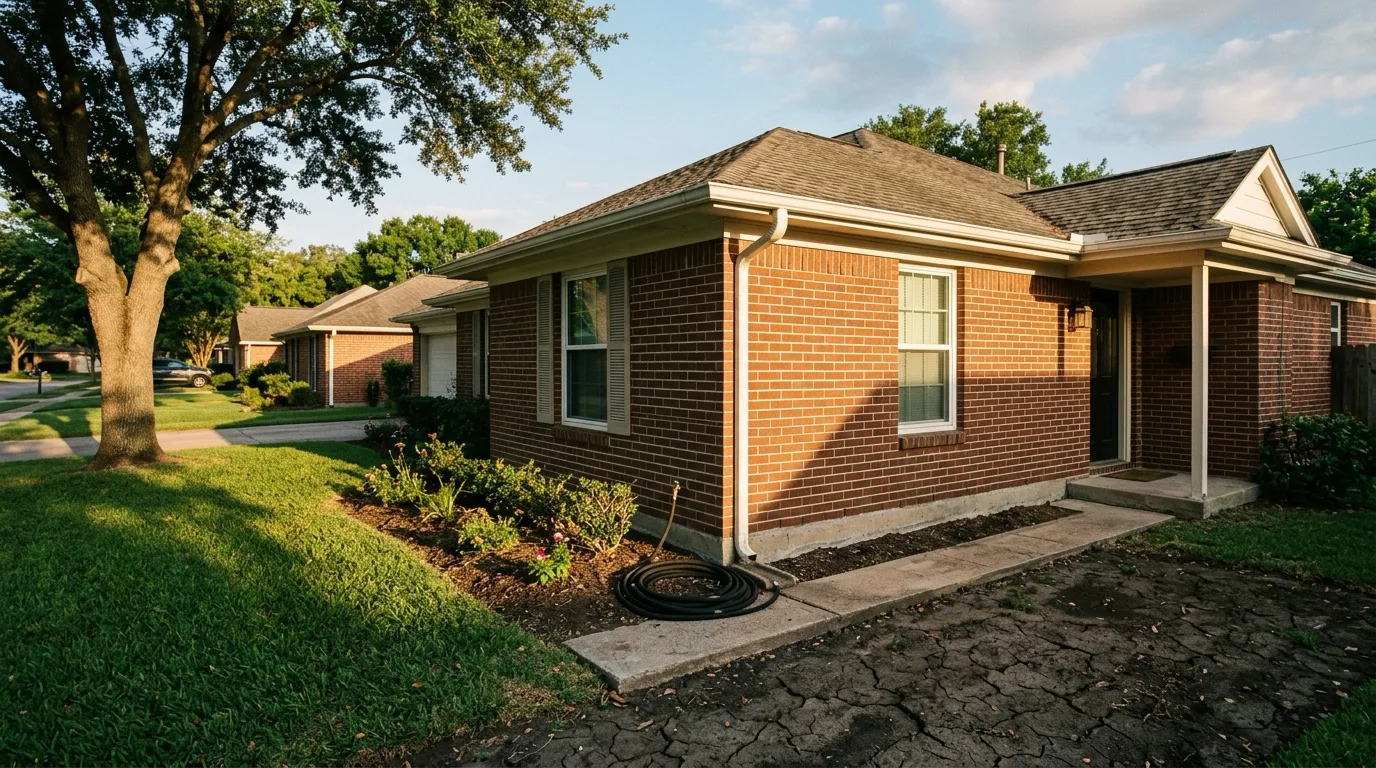
Many Houston-area clay soils shrink as they dry and swell as they take on water, and that movement can crack a foundation; the Texas Section of the American Society of Civil Engineers also lists landscaping, leaking plumbing and construction among the causes. The ground is not the same everywhere: federal soil data map high shrink-swell clay in parts of the Energy Corridor, and loamy soils across much of Katy and the Memorial Villages. A home inspector gives a written opinion on whether the foundation is performing. A licensed engineer measures it, explains the likely cause and designs any repair.
This guide is written by Energy Realty, a west Houston brokerage with offices in the Energy Corridor and in Katy. It sets out what Texas rules ask of an inspector, an engineer and a seller, as of October 2026. For a question about your own contract, ask a Texas real estate attorney.
Why do Houston foundations move?
“Texas has large areas with clayey soils that shrink and swell with changes in soil moisture content,” the Texas Section of the American Society of Civil Engineers (ASCE) writes in its guidelines for engineers who evaluate and repair house foundations, and “this shrinking and swelling may cause movement of residential foundations.” They also name “inadequate design or construction, unanticipated loads, deterioration of materials, compressibility of the supporting soils, landscaping practices, leaking plumbing, and slope instability.”
What matters is uneven movement. The Texas Real Estate Commission (TREC) separates uniform settlement, when the whole foundation settles evenly, which “is generally not harmful,” from differential settlement, when one part settles more than another, which “can lead to structural damage, including cracks and misalignment.”
Lake Charles clay shows the mechanism most clearly. The U.S. Department of Agriculture’s Natural Resources Conservation Service (NRCS) describes it as clay from the surface down, formed in clayey deposits of the Beaumont Formation. When it dries, cracks 1 to 5 centimeters (1/2 to 2 inches) wide open at the surface, reach 12 inches deep or more and stay open 60 to 90 cumulative days in most years. Undisturbed, the ground forms gilgai, mounds 6 to 15 inches higher than the hollows between them.
Sources: ASCE Texas Section, Guidelines for the Evaluation and Repair of Residential Foundations, Version 3, Section 1.2; TREC, Rendering an Opinion of Foundation Performance; USDA NRCS, Lake Charles series description. Retrieved October 28, 2026.
Is all of west Houston built on expansive clay?
No. NRCS soil survey data for Harris, Fort Bend, and Austin and Waller counties, in survey versions dated September 2026, show a mix that changes within a few miles, and the reason NRCS gives for a poor rating is often wetness, not shrink-swell.
| Area | Soils mapped there (examples) | NRCS rating and reason |
|---|---|---|
| Energy Corridor area, Kirkwood Road to Barker Cypress Road, I-10 to Westheimer Road | Bernard clay loam; Lake Charles clay; Lake Charles-Urban land complex; loamy Katy, Cyfair and Clodine soils | Lake Charles: very limited, shrink-swell. Bernard clay loam: very limited, depth to saturated zone; like Lake Charles, it formed in clayey Beaumont Formation deposits. Cyfair: somewhat limited, depth to saturated zone. |
| Memorial Villages | Gessner occasionally ponded-Urban land complex across much of the area; Addicks-Urban land complex; Aldine-Urban land complex | Gessner: very limited, ponding and depth to saturated zone. Addicks: somewhat limited, depth to saturated zone. Aldine: very limited, shrink-swell. |
| Katy area | Katy-Urban land complex across much of the area; Clodine-Urban land complex; Cyfair-Urban land complex | Katy: not limited. Clodine: very limited, depth to saturated zone. Cyfair: somewhat limited, depth to saturated zone. |
In NRCS terms, “very limited” means limitations that “generally cannot be overcome without major soil reclamation, special design, or expensive installation procedures.” The ratings assume reinforced concrete footings about 2 feet deep, so they describe the ground, not how a particular foundation was engineered.
Shrink-swell is recorded as linear extensibility, the change in length of a clod of soil as it dries. In the Harris County records, Lake Charles clay layers carry representative values of about 11 to 14 percent. The Katy soil is a fine sandy loam at about 1 percent or less near the surface; its clay loam subsoil, which begins within about 2 feet, is recorded at up to about 4 percent.
So Katy is not one continuous clay pan, but a Katy house can still move: its subsoil is clay loam, and drainage and plumbing leaks matter anywhere. In the Memorial Villages the warning is more often water: NRCS describes Gessner as a poorly drained, very slowly permeable soil in depressions. Our flood guide covers flood maps and the reservoirs.
NRCS notes that “onsite investigation may be needed to validate these interpretations and to confirm the identity of the soil on a given site.” Look up the address in the NRCS Web Soil Survey, then let the engineer’s site visit, and soil testing if needed, settle it.
Sources: USDA NRCS, Soil Data Access (survey areas TX201 Harris County, TX157 Fort Bend County, TX600 Austin and Waller Counties), dwelling ratings and linear extensibility; NRCS series descriptions for Katy, Gessner, Bernard and Lake Charles. Retrieved October 28, 2026.
Slab-on-ground or pier and beam: what is under the house?
The inspector must report the type of foundation, and TREC’s Property Inspection Report form, REI 7-6, opens its structural section with a line for it. On a pier-and-beam house the inspector must also report the vantage point from which the crawl space was inspected, and is not required to enter one with headroom under 18 inches or an opening smaller than 24 inches wide and 18 inches high, so read that line.
| Slab-on-ground | Pier and beam | |
|---|---|---|
| What the inspector reports | Visible indications such as binding doors, sloping floors, cracks and masonry movement; deteriorated materials and exposed or damaged reinforcement as Deficient | The same indications, plus deficiencies in beams, joists, piers, posts, sills or subfloor, and crawl space ventilation or drainage that is not performing |
| Repair methods in the ASCE Texas Section guidelines | Underpinning, grouting, mudjacking, crack injecting, tendon stressing, partial demolition and reconstruction | Shimming the framing on the existing supports, repairing framing, replacing or adding supports, re-establishing void space |
| City of Houston permit submittal | Plans and details by a Texas-licensed engineer showing the location, quantity and type of supports, piers or pressed piles | Block-and-base work within the city’s engineered limits: the City Engineer Detail and a site-specific foundation plan or layout; level-and-shim or minor beam replacement: a Repair Per Spec list |
Sources: 22 Texas Administrative Code Section 535.228(a), via Cornell LII; TREC Form REI 7-6; ASCE Texas Section guidelines, Sections 7.4.3 and 7.5; Houston Permitting Center, Foundation repair (HPWFMO1010). Retrieved October 28, 2026.
What a TREC home inspector must report about a foundation
Texas home inspectors work to TREC’s Standards of Practice, 22 Texas Administrative Code Sections 535.227 to 535.233, last amended effective February 1, 2022. Section 535.228(a) requires the inspector to “render a written opinion as to the performance of the foundation” and to “generally report present and visible indications used to render the opinion of adverse performance,” such as binding doors, frieze board separations, sloping floors, cracks and masonry movement. Drainage around the foundation that is not performing, and deficient gutters and downspouts, are reported as Deficient.
In practical terms, TREC tells inspectors, a foundation is performing “when it remains reasonably flat and level.”
What the inspector is not required to do
- Measure. An inspection does not require “elevation determination devices” or “elevation measurement.”
- Diagnose or predict. The inspector need not determine “the cause or source of a condition” or anticipate the “future performance of any item.”
- Prescribe or price. The standards exclude “engineering, architectural, appraisal, mitigation, physical surveying, realty, or other specialist services” and “repair cost estimates.”
- Read the paperwork. The inspector need not review “repair plans, cost estimates, disclosure documents, or other reports,” or report past repairs that “appear to be effective and workmanlike.”
The Texas Board of Professional Engineers drew the same line in Policy Advisory Opinion 43: an inspector who follows the standards “does not engage in the practice of engineering,” but “analyzing the cause of a condition, recommendations for repair, or providing any other expert engineering opinion associated with a foundation” is engineering. The report form adds that further evaluations are the client’s responsibility, and TREC recommends they “take place prior to the expiration of any contractual time limitations, such as option periods.”
Sources: 22 Texas Administrative Code Sections 535.227 and 535.228, via Cornell LII; TREC, Rendering an Opinion of Foundation Performance; TREC Form REI 7-6; Texas Board of Professional Engineers, Policy Advisory Opinion 43 (February 2018). Retrieved October 28, 2026.
When to hire a licensed engineer, and what the evaluation contains
Bring in a Texas-licensed professional engineer when the inspector reports adverse indications or marks the foundation Deficient, when the disclosure lists a previous structural repair or soil movement, or when you are relying on someone else’s repair. Texas law lists “investigation, evaluation, analysis” and “engineering for construction, alteration, or repair of real property” among the practices of engineering.
The ASCE Texas Section’s guidelines, Version 3, adopted in 2022, are guidelines, not law; adherence is voluntary unless a law or contract makes it mandatory. They set out three levels of investigation, and the scope “shall be jointly established and agreed to by both the client and engineer,” so ask which level you are buying.
| Report | What it contains | What it does not do |
|---|---|---|
| TREC home inspection | A written opinion on whether the foundation is performing, the visible indications behind it, and Deficient components | No measurement, cause, repair design or cost |
| Engineer, Level A | A report “of first impressions”: the property’s history, review of drawings and previous repair information, a walk-through, conclusions | No floor elevation survey |
| Engineer, Level B | Level A plus relative floor elevations, a scaled drawing, and overall deflection, localized deflection and tilt compared with acceptable tolerances | No testing beyond the survey |
| Engineer, Level C | Level B plus testing the engineer judges appropriate, such as soil sampling, plumbing or material testing, and a tree survey | Repair plans are a separate document |
How the engineer reads the numbers
“A single floor level survey yields the shape of the foundation at one instant,” the guidelines note, and slabs are built with some unevenness, so “caution is advised when evaluating floor deviations over a distance less than approximately 20 feet.” The guidelines borrow L/360, the International Residential Code’s deflection limit for floor members, as an analogous limit for a foundation; above it, with sufficient symptoms, the engineer generally will be justified in finding excessive deflection. “A tilt greater than 1 percent is usually noticeable.” If the builder recorded Original Construction Elevations, the engineer can measure change rather than shape, so ask the seller for them.
What the written report should show
The guidelines list scope, property description, sources of information, data, assumptions, analysis, conclusions, recommendations and limiting conditions. Texas engineering rules require evaluations and recommendations to bear the engineer’s printed name, date, signature and the designation P.E., and repair plans to bear the engineer’s seal. Check the license on the state board’s PE roster. The guidelines say “it is essential to avoid conflicts of interest,” so ask whether the engineer has a financial tie to the repair company.
Sources: Texas Occupations Code Section 1001.003(c); 22 Texas Administrative Code Section 137.33(f), in the TBPELS Acts and Rules handbook (effective June 18, 2026); TBPELS engineering rosters; ASCE Texas Section guidelines, Sections 1.4, 2.2, 3.1, 5.4 to 5.6 and 6. Retrieved October 28, 2026.
What a Texas seller must disclose about the foundation
Texas Property Code Section 5.008 requires the seller of a one-unit home to give the buyer a written notice of the property’s condition; TREC’s version is Form 55-1, effective May 28, 2026. Foreclosure sales and never-occupied new homes are exempt. It “shall be completed to the best of seller’s belief and knowledge as of the date the notice is completed and signed,” and a seller who does not know an answer must say so. It is due on or before the contract’s effective date; delivered later, the buyer “may terminate the contract for any reason within seven days after receiving the notice.”
Four items reach the foundation. Item 3 asks about known defects in the “Foundation/Slab(s),” walls, floors, doors and “Other Structural Components.” Item 4 asks about “Previous Structural or Roof Repair,” “Improper Drainage,” “Water Damage Not Due to a Flood Event” and “Landfill, Settling, Soil Movement, Fault Lines.” Item 5 asks about anything “in need of repair.” Item 9 asks about “structural modifications, or other alterations or repairs made without necessary permits or not in compliance with building codes in effect at that time.”
The form is “not a substitute for any inspections or warranties the purchaser may wish to obtain,” so for a buyer a No is a statement, not a measurement. For a seller, a repair you paid for is something you know: describe it, with dates, and attach the records below.
If you order an engineer’s evaluation before listing, its findings become part of what you know when you complete the notice, so plan to describe them there and keep the report with your foundation file. Ask a Texas real estate attorney how to word a past repair if you are unsure.
Sources: Texas Property Code Section 5.008(a), (d), (e) and (f); TREC Seller’s Disclosure Notice, Form 55-1, items 3, 4, 5 and 9. Retrieved October 28, 2026.
The foundation documents a seller should have ready
A Level A evaluation asks for “previous repair information,” so gather three sets of records before listing.
| Record | What it should include | Why a buyer asks for it |
|---|---|---|
| 1. The engineer’s evaluation | The level of investigation, any floor elevation data and drawing, conclusions and recommendations, signed with the engineer’s name, date and P.E. designation | Shows what was found, when and by whom |
| 2. The repair package | The sealed repair plans, the permit and its inspections, the floor elevation survey taken after the repair, and the engineer’s letter of substantial completion | The guidelines call for a post-repair survey furnished to the client and, if the engineer was retained for it, a completion letter |
| 3. The contract, invoices and warranty | The repair company’s scope of work, proof of payment, and the warranty with its transfer terms | A transferable warranty helps only if it can move to the buyer |
If a piece is missing, ask the engineer or the repair company for copies now, and read the warranty’s transfer clause before you list. Our guide to selling a home in the Energy Corridor, Memorial or Katy covers the rest of the preparation.
Sources: ASCE Texas Section guidelines, Sections 3.1.1, 7.7 and 7.8; TREC Form 55-1; 22 Texas Administrative Code Section 137.33(f). Retrieved October 28, 2026.
Permits for foundation repair: Houston, the Villages and Katy
City of Houston. The Houston Permitting Center’s foundation repair permit covers “the repair of the fractures in slabs” and “stabilizing a structure that has moved from its originally constructed design.” Plan review is required, and “pre-construction and final inspections are conducted.” In flood zones A, AO, AE, A1-30 and A99, the city also asks for a sealed cost estimate from a Texas engineer or architect, or a notarized foundation contract, plus an appraisal.
The Memorial Villages. Bunker Hill, Hedwig, Hilshire, Hunters Creek, Piney Point and Spring Valley are six separate cities, so the permit office is the Village’s, not Houston’s. Our guide to Houston’s lack of zoning and the Villages’ own zoning explains why the rules change at a Village line.
Katy. The City of Katy sits where Harris, Waller and Fort Bend counties meet, and much of what people call Katy lies outside its limits. Inside the city, ask its permit office; outside it, ask the county. Either way, keep the permit number and final inspection with the repair file.
Sources: Houston Permitting Center, Foundation repair (HPWFMO1010); Village Fire Department; Texas State Historical Association, Handbook of Texas, Katy; U.S. Census Bureau, 2024 Gazetteer. Retrieved October 28, 2026.
Foundation findings and the option period
In a Texas resale, the option period is when a foundation question gets answered. Under TREC’s resale contract, Form 20-19, the buyer pays the option fee within 3 days after the effective date and receives “the unrestricted right to terminate this contract” by notice within the days written in, by 5:00 p.m. local time. Without a timely option fee there is no unrestricted right.
The buyer may use inspectors “licensed by TREC or otherwise permitted by law to make inspections,” which includes a licensed engineer, but “any hydrostatic testing must be separately authorized by Seller in writing.” Plumbing leaks are among the causes of movement, so sellers should decide in advance and buyers should ask early. Book the inspection for the first days of the option period, and if the disclosure already shows a structural repair, book the engineer at the same time.
Later exits are narrower. A buyer who receives the disclosure after signing may terminate within 7 days under Paragraph 7B. The Third Party Financing Addendum allows termination, with the lender’s written statement, up to the 3rd day before closing if the lender rejects the property on appraisal, insurability or required repairs, and Paragraph 7E does if lender-required repairs exceed 5 percent of the price. Ask your agent or a Texas real estate attorney how the dates in your contract run.
Sources: TREC Form 20-19 (effective July 1, 2026), Paragraphs 5, 7A, 7B and 7E; TREC Form 40-11, Paragraph 2B; ASCE Texas Section guidelines, Sections 1.2 and 3.1.3. Retrieved October 28, 2026.
Will homeowners insurance pay for foundation repair?
Usually not. The Texas Department of Insurance says even all-risk policies “usually don’t pay to remove mold or repair your home’s foundation,” lists earth movement among common exclusions, and notes that some companies sell an endorsement for damage to foundations or slabs. Ask the insurance agent, in writing, what a quoted policy does for foundation damage. Our guide to homeowners insurance in west Houston covers the rest of the policy.
Sources: Texas Department of Insurance, All risk or named peril and Home insurance guide. Retrieved October 28, 2026.
What moves price when a foundation report comes back
- Whether the foundation is performing, and what the remedy is. Non-structural measures, such as watering, tree work, gutters and grading that slopes 5 percent away from the house for the first 10 feet, “may be a prudent approach” before or instead of structural repair, and “an owner may choose to perform periodic cosmetic repairs and door adjustments, rather than comprehensive foundation underpinning.”
- What a structural repair can and cannot do. “Perfection is not attainable by remedial measures.” Underpinning “will not improve the performance of the foundation in non-underpinned areas,” and “it is unlikely that elevation adjustments will result in a level foundation.” After a lift, water and drain lines should be tested for leaks.
- The lender and the insurer. An appraisal, insurability problem or lender-required repair can open a later exit under the financing addendum or Paragraph 7E.
- The scope behind the bid. The engineer’s plan sets the locations, sizes and depths of underpinning, and the engineer of record approves any change. That scope drives the cost, so get repair bids against the same sealed plan before you negotiate a number.
An agreement goes on TREC Form 39-11, the amendment, which can add specific repairs the seller completes before closing, change the sales price or the amount the seller pays toward the buyer’s expenses, or extend the option period for an added fee; the buyer can also terminate within the option period. For agreed repairs, Paragraph 7F requires the seller to obtain any required permits, use persons licensed for the work or, where no license is required, commercially engaged in it, document the scope and payment, and arrange the transfer of any transferable warranties at closing.
Sources: ASCE Texas Section guidelines, Sections 5.7, 7.1, 7.2, 7.3, 7.4.3.1 and 7.6; TREC Forms 20-19 (Paragraphs 7E, 7F and 12A), 39-11 and 40-11. Retrieved October 28, 2026.
Frequently Asked Questions
Why do foundations crack in Houston?
Many Houston clay soils shrink as they dry and swell as they get wet, and uneven movement can crack walls, slabs and brick. Engineers also point to design or construction, landscaping and leaking plumbing. Uniform settlement is generally not harmful, the Texas Real Estate Commission says; differential settlement can lead to cracks and misalignment.
Is Katy built on expansive clay?
Not uniformly. NRCS soil data map much of the Katy area as Katy-Urban land complex, a fine sandy loam over a clay loam subsoil whose recorded shrink-swell is about 4 percent or less, against about 11 to 14 percent for Lake Charles clay in parts of the Energy Corridor. A Katy house can still move, so the inspection, and an engineer if needed, answer it for the house.
What does a home inspector check on a foundation in Texas?
Under TREC’s Standards of Practice, the inspector gives a written opinion on whether the foundation is performing, reports its type and visible indications such as binding doors, sloping floors and cracks, and marks deficient components. The inspection is visual. It does not require elevation measurement, and the inspector is not required to determine the cause or recommend repairs, which is engineering work.
When should I hire an engineer for a foundation inspection?
When the home inspector reports indications of adverse foundation performance or marks the foundation deficient, when the seller’s disclosure lists a previous structural repair or soil movement, or when you are relying on someone else’s repair. TREC’s report form recommends that further evaluations happen before contractual deadlines, such as the end of the option period, so book the engineer early.
What is in a foundation engineer’s report?
The ASCE Texas Section guidelines describe three levels. Level A is a report of first impressions from a walk-through. Level B adds a floor elevation survey, a scaled drawing and deflection and tilt measured against tolerances. Level C adds testing such as soil sampling or plumbing tests. The evaluation must carry the engineer’s name, date, signature and P.E. designation.
Does a Texas seller have to disclose foundation repairs?
Yes, unless the sale is exempt, such as a foreclosure sale or a never-occupied new home, and to the extent the seller knows of them. Texas Property Code Section 5.008 requires a written notice, and TREC Form 55-1 asks about known foundation or slab defects, previous structural or roof repair, improper drainage, settling or soil movement, and repairs made without necessary permits. The seller answers Yes if aware or No if not, and explains each Yes.
What foundation documents should a seller have ready?
Three sets: the engineer’s evaluation; the repair package, meaning the sealed plans, the permit and inspections, the post-repair floor survey and the engineer’s completion letter; and the repair contract, invoices and warranty with its transfer terms. A buyer’s engineer reviews previous repair information, and the disclosure form asks about previous structural repair and unpermitted work.
Do I need a permit for foundation repair in Houston?
Inside the City of Houston, yes: the Houston Permitting Center lists a foundation repair permit with plan review and inspections, and a slab repair needs plans by a Texas-licensed engineer showing the piers or pressed piles. The Memorial Villages and the City of Katy are separate cities, so ask that city’s office; outside any city’s limits, ask the county.
Can I back out of a Texas home purchase over foundation problems?
If the contract has an option period, yes, during it. TREC’s resale contract gives a buyer who paid the option fee on time the unrestricted right to terminate by notice by 5:00 p.m. on the last option day, including over an engineer’s findings. After it ends, the exits are narrower, so ask a Texas real estate attorney.
Keep reading
Send us the address and the inspection report
If you are buying, tell us the house and when your option period ends, and we will go through the disclosure’s foundation lines and the inspector’s findings with you, and help you fit an engineer’s visit inside the window. If you are selling, we will help you assemble the foundation file before listing. Energy Realty works from offices in the Energy Corridor and in Katy.
Ask Energy Realty about a foundation report
Social Cookies
Social Cookies are used to enable you to share pages and content you find interesting throughout the website through third-party social networking or other websites (including, potentially for advertising purposes related to social networking).