
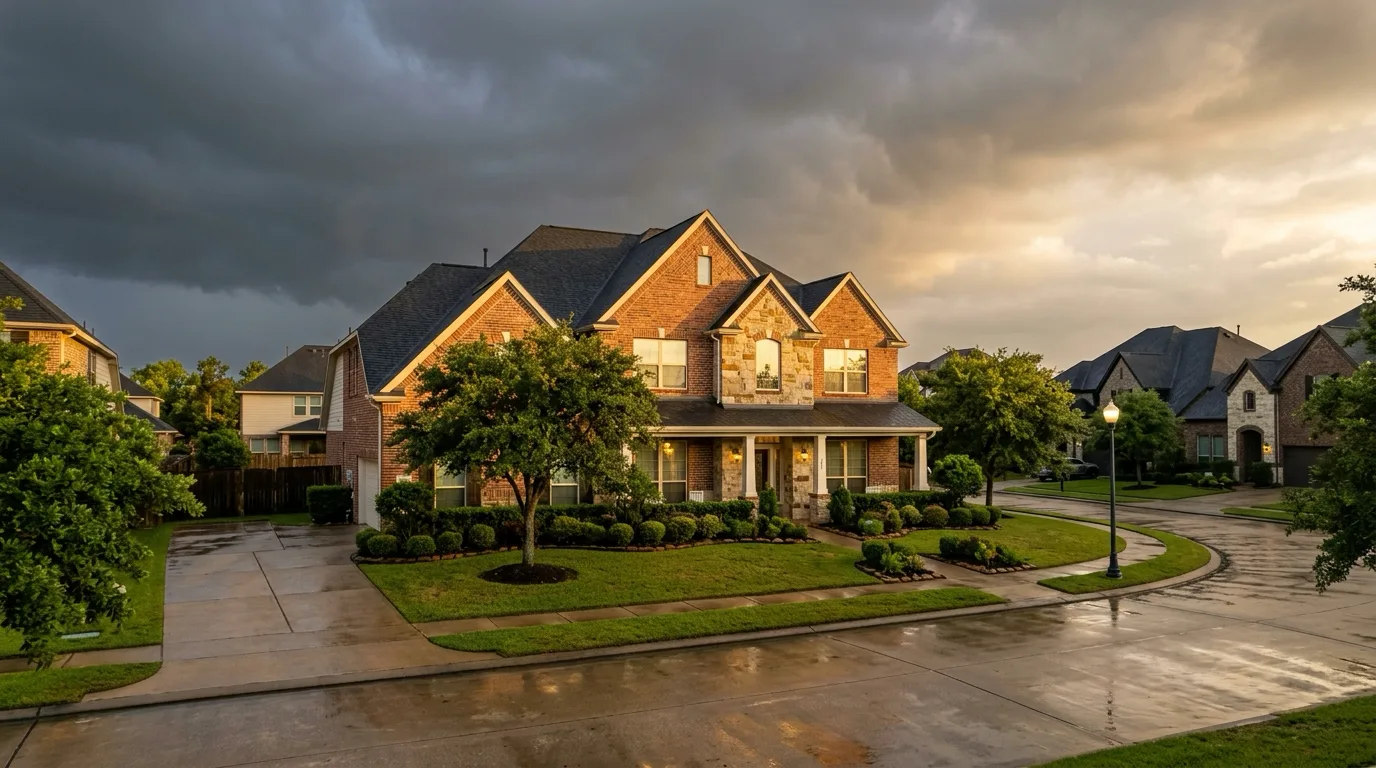
West Houston is outside the coastal area served by the Texas Windstorm Insurance Association, so a home in the Energy Corridor, Memorial or Katy normally carries wind and hail coverage inside its standard homeowners policy, which may set a separate deductible for wind and hail. Flood is not covered by a standard homeowners policy and needs a separate one. Texas Department of Insurance data for 2025 put the average homeowners premium with wind coverage at $4,144 in Harris County and $4,231 in Fort Bend County. The number a buyer should price in, though, is the quote for one address, read for its deductible and its roof terms while the option period is still open.
This guide is written by Energy Realty, a west Houston brokerage with offices in the Energy Corridor and in Katy, and it names no insurer. For advice on a specific policy, talk to a licensed insurance agent or your insurer. Every figure carries its source and date, as of October 2026.
Is west Houston in the Texas windstorm (TWIA) area?
No. The Texas Windstorm Insurance Association, or TWIA, writes wind and hail coverage only where the Commissioner of Insurance has designated a catastrophe area under Chapter 2210 of the Texas Insurance Code. TWIA describes that area as “all 14 first-tier coastal counties” and “parts of Harris County east of Highway 146.” The Texas Department of Insurance names the Harris County part precisely: areas “east of State Highway 146 and inside the city limits of the cities of Seabrook, La Porte, Shoreacres, Pasadena, and Morgan’s Point.”
The Energy Corridor, the Memorial area, the Memorial Villages and Katy are in none of those cities. Katy sits where Harris, Fort Bend and Waller counties meet, and neither Fort Bend nor Waller is designated. Harris and Fort Bend appear in Chapter 2210 as “second tier coastal” counties, which is why the question comes up, but designation is the Commissioner’s call, and in Harris County it covers only the parts of those five cities east of the highway. So the Department’s general guidance for most of Texas applies: away from the coast, “you probably have wind and hail coverage in your homeowners policy,” although “you may have a different deductible for windstorm damage.”
| Location | In the TWIA area? | Wind and hail coverage usually comes from |
|---|---|---|
| Energy Corridor, Memorial area, Memorial Villages | No | The homeowners policy, which may set a separate wind and hail deductible |
| Katy (Harris, Fort Bend and Waller portions) | No | The homeowners policy, which may set a separate wind and hail deductible |
| The 14 first-tier coastal counties, and the parts of Seabrook, La Porte, Shoreacres, Pasadena and Morgan’s Point that lie east of State Highway 146 | Yes | Often a separate wind policy from TWIA or another insurer; TWIA requires a prior denial and, generally, a windstorm certificate |
Sources: TWIA, Coverage and Eligibility; Texas Department of Insurance, Harris County catastrophe area and What is windstorm insurance?; Texas Insurance Code Sections 2210.003 and 2210.005. Retrieved October 12, 2026.
What a homeowners policy covers here, and what it does not
Most Texas home policies, the Department says, combine six coverages: dwelling, personal property, other structures, additional living expenses, personal liability and medical payments.
| Most policies cover damage from | Most policies do not cover damage from |
|---|---|
| Fire, lightning, explosion | Flooding |
| Sudden and accidental release of water or smoke | A continuous water leak; mold removal, except to repair damage from a covered risk |
| Theft and vandalism | Wear and tear; termites and pests |
| Windstorm, hurricane and hail (not on the Gulf Coast) | Earthquakes or earth movement |
Where a house sits on expansive clay, one exclusion deserves attention. Even all-risk policies “usually don’t pay to remove mold or repair your home’s foundation,” the Department notes, and some companies sell foundation and sewer backup endorsements. Our guide to Houston foundations and clay soil explains the engineer’s report. Ask the agent, in writing, whether the policy pays for any foundation repair and whether a foundation endorsement is offered.
Two terms decide what a claim pays. Replacement cost coverage pays to repair or rebuild at current prices; actual cash value pays replacement cost minus depreciation. “To be fully protected, make sure your policy has replacement cost coverage,” the Department advises, adding that most mortgage companies require it. The amount matters too: “Most companies require you to insure your house for at least 80% of its replacement cost,” and some require 100 percent. Replacement cost is the cost to rebuild, not the contract price, and it excludes the land.
Sources: Texas Department of Insurance, Home insurance guide, All risk or named peril, shopping tips; Texas FAIR Plan Association, coverage summary. Retrieved October 12, 2026.
Wind and hail deductibles: find the number in dollars
The Department’s warning on deductibles is that one “may be a specific dollar amount or a percentage,” and if it is a percentage, “make sure you know how that translates to a dollar amount.” Its example uses homes insured for $150,000. A policy with a $500 deductible pays $6,000 toward a $6,500 roof repair after hail. A policy with a 5 percent deductible, which is $7,500 on that house, pays nothing.
The deductible “will be applied to each claim,” not once a year, and the wind and hail deductible can differ from the one for other damage, so ask for both. A higher deductible lowers the premium; moving from $500 to $1,000 “can save as much as 20 percent,” the Department says.
Round numbers, to show the arithmetic only. A house insured for $400,000 of dwelling coverage with a 2 percent wind and hail deductible carries an $8,000 deductible on any wind or hail claim; at 1 percent it is $4,000. A $6,000 hail repair is paid nothing at 2 percent and $2,000 at 1 percent. Because the percentage applies to the insured value, the dollar amount rises whenever the coverage does.
Sources: Texas Department of Insurance, What to know about deductibles; the worked example is hypothetical. Retrieved October 12, 2026.
How the roof affects the premium and the claim payment
The Department lists “your home’s roof age and material” among the common pricing factors. “Your insurance company will inspect your roof when you apply for insurance. They may charge you more or refuse to insure you based on what they see.” As roofs age, “some companies will switch to actual cash value,” and a roof in poor condition may not be covered at all. The Department’s example shows why that matters: a $10,000 roof on a house insured for $200,000 with a 2 percent, or $4,000, deductible.
| Coverage and roof age | Value of the roof | Minus deductible | Policy pays |
|---|---|---|---|
| Replacement cost, any age | $10,000 | $4,000 | $6,000 |
| Actual cash value, 5-year-old roof | $8,500 | $4,000 | $4,500 |
| Actual cash value, 10-year-old roof | $7,000 | $4,000 | $3,000 |
| Actual cash value, 20-year-old roof | $4,000 | $4,000 | $0 |
The Texas seller’s disclosure asks for the roof type, its approximate age and any previous structural or roof repair. Read those lines before you offer, read the inspector’s roof section during the option period, and ask how the quote pays the roof at that age.
Sources: Texas Department of Insurance, Insurance and your roof, Replacement cost or actual cash value? and cost factors page; TREC Form 55-1. Retrieved October 12, 2026.
Flood is a separate policy
A standard homeowners policy does not cover flood. Flood coverage comes from the National Flood Insurance Program or a private insurer, and a federally regulated or insured lender must require it when the home is in a Special Flood Hazard Area. The Harris County Flood Control District’s Harvey report is the reason to quote it elsewhere too: 68 percent of the 154,170 county homes that flooded were outside the 100-year floodplain. FEMA says an NFIP policy typically has a 30-day waiting period, but a policy bought in connection with the loan takes effect at closing. Our flood guide covers the maps, the reservoir flood pools and the disclosure. Quote flood on the address before you offer.
Sources: Consumer Financial Protection Bureau; 42 U.S.C. Section 4012a(b); FEMA; Harris County Flood Control District, Harvey report (final). Retrieved October 12, 2026.
How much homeowners insurance costs in Harris and Fort Bend counties
The Department publishes average annual homeowners premiums for every Texas county from 2019 to 2025, for policies active at each year’s end, drawn from the Texas Statistical Plan for Residential Risks. Outside the TWIA area the county figure covers policies that include wind.
| Area and year | Policies counted | Average premium | Average coverage |
|---|---|---|---|
| Harris County, 2019 | With wind coverage | $2,406 | $313,000 |
| Harris County, 2025 | With wind coverage | $4,144 | $463,000 |
| Fort Bend County, 2019 | With wind coverage | $2,363 | $342,000 |
| Fort Bend County, 2025 | With wind coverage | $4,231 | $503,000 |
| Waller County, 2025 | With wind coverage | $2,939 | $397,000 |
| Texas statewide, 2025 | All homeowners (preliminary) | $3,489 | $432,800 |
Read the columns together: “not only do rate changes affect premiums, but coverage amounts do, too,” the Department notes. The house’s age, roof, construction, deductible and claims history all move a quote away from the county figure. Use the table to sanity-check a quote, never to replace one.
Sources: Texas Department of Insurance, Texas homeowners insurance market overview, county map and statewide charts. Retrieved October 12, 2026.
Why home insurance costs more in Texas than it did
Insurers “set prices to match the cost of future claims,” the Department explains. It names the drivers: Texas weather, including “freezes, hurricanes, hailstorms, tornadoes, wildfires, major thunderstorms”; higher reinsurance rates, the insurance insurers buy; and inflation in building materials and labor. Wind and hail have averaged 62 percent of homeowners losses since 2019.
Average statewide rate changes for homeowners, renters, condo and mobile home policies combined were 21.1 percent in 2023, 18.7 percent in 2024 and 4.3 percent in 2025. The Department does not set rates; companies file them and “can use the new rates the same day they send them to TDI,” subject to review. As of October 2026, its market snapshot lists a 30-day filed rate request figure of -6.6 percent for September 2026; that describes company filings, not any one renewal, and is not a forecast.
Sources: Texas Department of Insurance, cost factors page, market overview and June 22, 2026 release. Retrieved October 12, 2026.
Claims history: what follows the house, and what Texas law keeps out
Insurers “look at a property’s past claims and use that as a factor in deciding how much you’ll pay,” the Department says, and most get them from the Comprehensive Loss Underwriting Exchange, or CLUE. A CLUE report “shows the claims filed for any house or car for the past seven years,” including claims under earlier owners. The Department’s advice to buyers is direct: “If you’re buying a house, you can ask the owner to show you a CLUE report for the property.”
Texas law limits what insurers may do with some of that history:
- Questions are not claims. Insurance Code Section 551.113 bars using a “customer inquiry,” a communication about coverage “that does not result in an investigation or claim,” to decline, cancel or nonrenew a homeowners policy. Section 544.553 bars rating based solely on one.
- Renewal limits. Under Section 551.107, an insurer may surcharge at renewal after two or more claims in three policy years, and may nonrenew after three, but only if it warned the policyholder after the second. Natural-cause claims, unpaid claims and certain appliance claims do not count.
- Repaired appliance leaks. Section 544.353 bars using a prior appliance water claim against a property if it was properly remediated and the work inspected and certified, unless there were three or more in three years.
- Remediated mold. Section 544.303 bars underwriting on past mold damage remediated under a certificate issued under Occupations Code Section 1958.154.
Section 551.107 protects a policyholder at renewal; a buyer is a new applicant, and a weather claim still appears on the house’s report. So ask the seller for the claims report early, and for the certificate behind any water or mold claim, which is what brings the statute into play.
Insurers “aren’t supposed to report any questions you ask about your policy or deductible,” the Department says. Be clear “whether you’re filing a claim or just asking a question.”
Sources: Texas Department of Insurance, How to get a CLUE about your claims history; Texas Insurance Code Sections 544.303, 544.353, 544.553, 551.107 and 551.113. Retrieved October 12, 2026. For a disputed decision, ask a Texas insurance attorney.
The Texas FAIR Plan, when a house is hard to insure
When no standard insurer will write a house, the backstop is the Texas FAIR Plan Association, a “residual market carrier” and “insurer of last resort” that the Legislature authorized in 1995 and that was activated statewide in 2002. TDI’s 2025 county data counted 28,616 FAIR Plan policies in Harris County. Applicants “must have been denied coverage by at least two insurance companies licensed to write and actually writing property insurance in Texas,” apply only through an agent, and must reapply in the regular market every two years. The Plan can still decline a house in disrepair or a vacant one.
The coverage is narrower. Dwelling coverage is actual cash value unless the homeowners policy is endorsed for replacement cost, which requires insuring to 100 percent of replacement cost. Perils such as falling trees, frozen plumbing and sewer backup are excluded, and dwelling coverage tops out at $1,000,000. Outside the coastal catastrophe area a FAIR Plan policy can include wind and hail. The Department says FAIR Plan and surplus lines coverage “is more expensive than coverage from a standard insurance company.”
For a buyer, a declined application is usually information about the house. If you ask, a company must tell you in writing why it turned you down, and the reason, often the roof or unrepaired damage, is something to negotiate inside the option period. Confirm any FAIR Plan policy meets the lender’s terms. Form 55-1 asks the seller the same question: whether the seller “has been unable to insure the Property for any reason.”
Sources: Texas FAIR Plan Association, Coverage and Eligibility, About Us and coverage summary; Texas Department of Insurance, Home insurance guide; TREC Form 55-1 (effective May 28, 2026). Retrieved October 12, 2026.
What the lender requires, and when
Texas law does not require homeowners insurance, but “if you still owe money on your home, your lender will require you to have it,” the Department says. The Consumer Financial Protection Bureau lays out the sequence among its closing steps: get written quotes, ask your loan officer whether they meet the lender’s requirements, then choose a policy and send the final information. You choose the insurer.
The resale contract, TREC Form 20-19, adds two terms. It tells both parties to “consult your insurance agent prior to change of ownership and possession because insurance coverage may be limited or terminated,” a reason not to move in early without a written lease. And its casualty loss paragraph requires the seller to restore fire or other casualty damage that occurs after the contract’s effective date by the closing date; if the seller cannot for reasons beyond the seller’s control, the buyer may terminate, extend closing by up to 15 days, or accept the property with an assignment of the insurance proceeds, if the seller’s insurer permits it, and a credit for the deductible. Our relocation guide sets out the rest of a Houston move.
Sources: Consumer Financial Protection Bureau, Shop for homeowner’s insurance; TREC Form 20-19 (effective July 1, 2026), Paragraphs 10 and 14. Retrieved October 12, 2026.
Insurance steps for a buyer under contract
In a Texas resale the option period is the buyer’s insurance window. Form 20-19 gives the buyer “the unrestricted right to terminate this contract” by notice within the agreed number of days, by 5:00 p.m. local time on the deadline, as long as the option fee is delivered on time. Ask your agent or a Texas real estate attorney how the dates in your contract run.
| Stage | What to do |
|---|---|
| Before the offer | Read the disclosure lines on roof age, roof repair, water damage, flood and present insurance. Get a flood quote and HelpInsure.com sample rates. Ask for the claims report. |
| During the option period | Get written quotes with the inspection report in hand. Confirm the wind and hail deductible in dollars, how the roof is paid, and any endorsements. If declined, ask why in writing, then renegotiate or terminate. |
| Before closing | Choose the policy, start it at closing, and send it to the loan officer. Bind a lender-required flood policy for closing, or buy a voluntary one at once because of the 30-day wait. |
| Closing and possession | No early move-in without a written lease and an insurance check. Damage after the effective date falls under the casualty loss paragraph. |
| First renewal | Check roof coverage, deductibles and the house details insurers price on; correcting wrong details could save money, the Department says. |
Sources: TREC Forms 20-19 (Paragraph 5) and 55-1; Texas Department of Insurance, renewal checklist. Retrieved October 12, 2026.
How to shop, and what to ask
The state’s comparison tool is HelpInsure.com, run by the Texas Department of Insurance and the Office of Public Insurance Counsel. It shows “policies sold in your area, their rates, and coverage types,” plus a company’s financial rating and complaint index. The Department publishes complaint indexes by company on the Texas Open Data Portal, and its Help Line, 800-252-3439, confirms whether an agent or company is licensed. Then ask every agent the same questions:
- What is the wind and hail deductible in dollars, and does it differ from the deductible for other damage?
- Is the roof paid at replacement cost or actual cash value at its age, and when would that change?
- What is excluded for foundation movement, continuous leaks, mold and sewer backup, and which endorsements are offered?
- Which discounts apply, such as an impact-resistant roof, a monitored alarm or a claim-free history?
- Will the company inspect after the policy starts? The Department notes a company may cancel in the first 60 days over an undisclosed risk.
- Does the policy meet my lender’s requirements?
Sources: HelpInsure.com; Texas Department of Insurance, complaint data, shopping tips and Home insurance guide. Retrieved October 12, 2026.
For sellers: what to have ready
A buyer’s insurer prices your house during the option period, so have the paperwork ready before listing. Our guide to selling a home in the Energy Corridor, Memorial or Katy covers the rest of the preparation.
- The declarations page of your current policy: coverages, limits and deductibles.
- The property’s claims report. The Department says a CLUE report “can help potential buyers know the condition of the house they’re buying.”
- The roof record: type, approximate age, and the invoice and permit for any replacement.
- Remediation paperwork for any water or mold claim, which is what Sections 544.353 and 544.303 turn on.
- Complete answers on Form 55-1, including the insurance, windstorm and unable-to-insure lines.
- Coverage in force until closing. Under the contract you must restore fire or other casualty damage that happens after the effective date, by closing. If you move out early, tell your insurer: the Department says most companies stop coverage, though usually not liability coverage, when a house is vacant 60 days or more, and each policy sets its own vacancy terms.
Sources: Texas Department of Insurance, Home insurance guide and CLUE guidance; TREC Forms 55-1 and 20-19. Retrieved October 12, 2026.
Frequently Asked Questions
Do I need windstorm insurance in Katy or west Houston?
Not as a separate policy, in most cases. The Texas Windstorm Insurance Association writes only in 14 coastal counties and the parts of Seabrook, La Porte, Shoreacres, Pasadena and Morgan’s Point that lie east of State Highway 146. Katy, the Energy Corridor and Memorial are outside that area, so wind and hail are normally covered by the homeowners policy itself. Check its wind and hail deductible, which may differ from the deductible for other damage.
Which part of Harris County is in the TWIA coverage area?
Only the area east of State Highway 146 inside the city limits of Seabrook, La Porte, Shoreacres, Pasadena and Morgan’s Point, according to the Texas Department of Insurance. The rest of Harris County, including the Energy Corridor and the Memorial area, is not a designated catastrophe area, and neither are Fort Bend and Waller counties. Being a second tier coastal county under Insurance Code Chapter 2210 does not by itself make a property eligible.
How does a wind and hail deductible work in Texas?
It is subtracted from each wind or hail claim, and it may be a flat amount or a percentage of the home’s insured value. In the Texas Department of Insurance’s example, a 5 percent deductible on a home insured for $150,000 is $7,500, so a $6,500 roof repair is paid nothing. Ask whether your wind and hail deductible differs from the one for other damage, and convert any percentage into dollars.
How much is homeowners insurance in Houston?
It depends on the house, the coverage amount and the insurer, so only a quote for the address answers it. For orientation, Texas Department of Insurance data for 2025 show an average annual premium of $4,144 for Harris County homeowners policies with wind coverage, with average coverage of $463,000, and $4,231 in Fort Bend County. The preliminary 2025 statewide average for all homeowners policies was $3,489.
Why is home insurance so expensive in Texas?
The Texas Department of Insurance points to the cost of claims, from freezes, hurricanes, hailstorms, tornadoes and thunderstorms, plus higher reinsurance costs and inflation in building materials and labor. Wind and hail have averaged 62 percent of homeowners losses since 2019. Average statewide rate changes were 21.1 percent in 2023 and 18.7 percent in 2024, then 4.3 percent in 2025, and average coverage amounts have risen too.
What is the Texas FAIR Plan?
The Texas FAIR Plan Association is the state’s insurer of last resort for homeowners who cannot find a standard policy. You must have been turned down by at least two insurance companies writing property insurance in Texas, and you apply through a licensed agent. Its coverage is narrower: dwelling coverage is actual cash value unless endorsed for replacement cost, and perils such as falling trees and frozen plumbing are not covered.
Does homeowners insurance cover flooding in Houston?
No. A standard homeowners policy does not cover flood, which needs a separate policy from the National Flood Insurance Program or a private insurer. A federally regulated or insured lender must require one in a Special Flood Hazard Area. A voluntary NFIP policy typically has a 30-day waiting period, but a policy bought in connection with the loan takes effect at closing.
Can a previous owner’s insurance claims affect my premium when I buy a house in Texas?
They can. The Texas Department of Insurance says insurers look at a property’s past claims, usually through a CLUE report covering the past seven years, including claims under earlier owners. Texas law limits some uses: a remediated appliance water claim that was inspected and certified, or remediated mold with a certificate, generally cannot be held against the property. Ask the seller for the claims report before you offer or early in the option period.
When do I need homeowners insurance when buying a house?
Before closing, if you are borrowing. Texas law does not require home insurance, but a lender will, and the Consumer Financial Protection Bureau lists choosing a policy and sending it to your loan officer among the steps before closing. Shop during the option period, when you can still terminate the contract, and set the policy to start at closing.
Keep reading
- Buying a home in a Houston flood zone: flood maps, the Addicks and Barker reservoirs, insurance and disclosure
- Living in the Energy Corridor, Houston: the complete guide
- Living in Katy, Texas: the complete guide
- Memorial, Houston real estate guide
- MUD districts and Houston property taxes explained
- Relocating to Houston for an energy job
Send us the address before the option period starts
Tell us the house you are considering. Once the seller’s disclosure is available, we will go through its lines on the roof, water damage, insurance and flood with you, and give you the questions to put to your insurance agent while you can still renegotiate or walk away. Energy Realty works from offices in the Energy Corridor and in Katy.
Ask Energy Realty about a specific address
Social Cookies
Social Cookies are used to enable you to share pages and content you find interesting throughout the website through third-party social networking or other websites (including, potentially for advertising purposes related to social networking).